
Picture this: A potential customer hears about your business, pulls out their phone, types in your website URL, and then... waits. The screen is blank. A spinner appears. Disappears. Appears again. After about four seconds of this existential uncertainty, they do what most of us do: they hit the back button and try the next result.
You just lost a customer. Not because your prices were wrong. Not because your product was bad. Because your website made them wait three seconds longer than a TikTok video.
We live in the most impatient era in human history, and slow websites pay the price for it every single day.

- 53% — of mobile visits were abandoned when a page took longer than 3 seconds to load, in Google’s 2016 study
- 8.4% — more retail conversions after a 0.1-second improvement in mobile site speed, in Deloitte and Google’s 2020 study (10.1% for travel sites)
Why Is Your Website Slow? (The Usual Suspects)
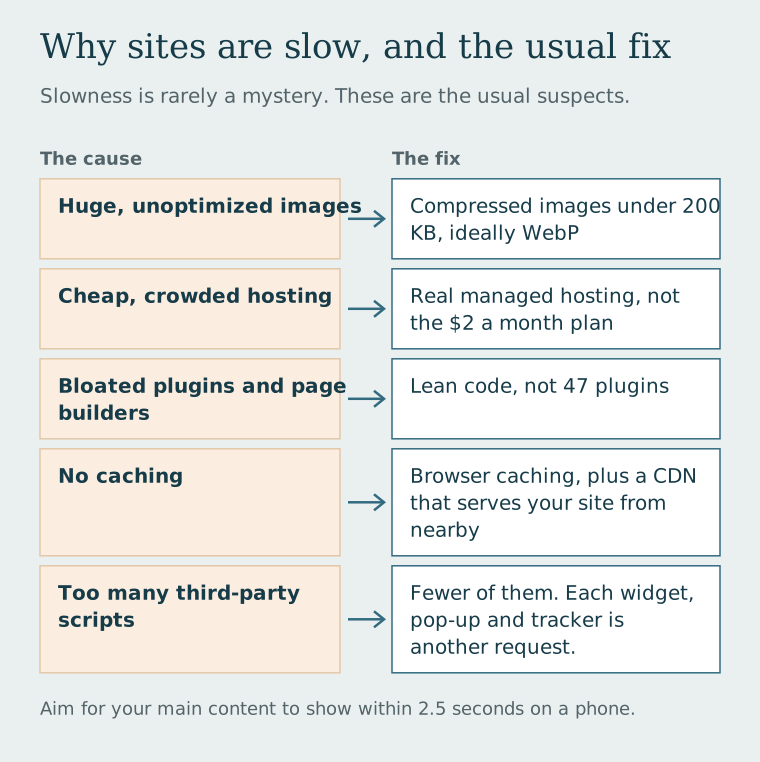
Slow websites are almost never a mystery. There are a handful of usual culprits that account for the vast majority of sluggish loading times:
- Unoptimized images — Someone uploaded a raw photo from their DSLR camera (8MB) directly to the website. Your browser is now trying to download a small novel before it can show you a picture of a storefront.
- Cheap hosting — Bargain basement hosting puts your website on a server with hundreds of other sites, all competing for the same resources. Your site loads when it gets around to it.
- Bloated plugins or page builders — Some drag-and-drop website builders load 200KB of JavaScript even when you only need to show text. That's the website equivalent of driving a dump truck to pick up a coffee cup.
- No caching — Without caching, your website rebuilds itself from scratch every time someone visits. With caching, it keeps a fast copy ready to serve instantly.
- Too many third-party scripts — Chat widgets, pop-ups, analytics tools, ad trackers. Each one is a separate request that slows everything down.
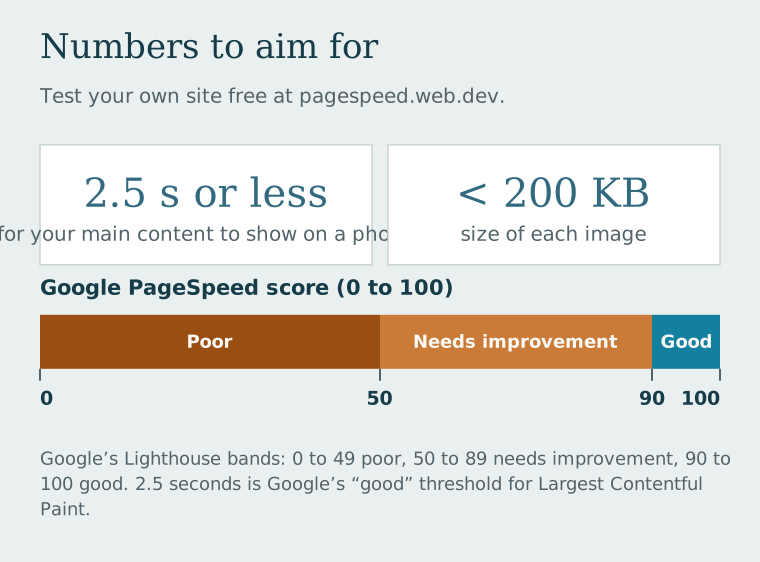
Go test your site right now: Visit pagespeed.web.dev and type in your URL. Google will tell you your score and — crucially — exactly what's slowing you down. Google rates a score of 0 to 49 as poor, 50 to 89 as needing improvement, and 90 to 100 as good.
Speed Also Affects Your Google Ranking
Google officially uses page speed as a ranking factor. What this means in practice: a faster website ranks higher than a slower one, all else being equal. Two businesses offering the exact same service in the same town — the faster site can appear higher in search results. Speed is only one of many signals, but it is one you control.
So a slow website doesn't just frustrate the visitors you have. It reduces the number of visitors you get in the first place. You lose twice.
The good news: Speed fixes are often cheaper than a redesign, and even small gains count. Deloitte and Google found that a 0.1-second improvement on mobile was linked to more conversions. You don't need to build a new site — sometimes you just need it fixed.
What Makes a Website Fast?
- Good hosting — Not the $2/month plan. A real managed hosting provider with fast servers.
- Compressed images — All images under 200KB, ideally in modern formats like WebP.
- Lean code — A site built by someone who knows what they're doing, not bolted together with 47 plugins.
- A CDN (Content Delivery Network) — Serves your site from servers close to your visitor, cutting load time dramatically.
- Browser caching — So repeat visitors get a near-instant experience.
A good target is for your main content to show up within 2.5 seconds on a phone, which is Google's threshold for a good Largest Contentful Paint. Not for Google. Not for bragging rights. But because every second under that threshold is money staying in your business instead of walking out the door.
Is your website fast enough?
We'll run a free speed audit and show you exactly what's holding it back — then fix it.